
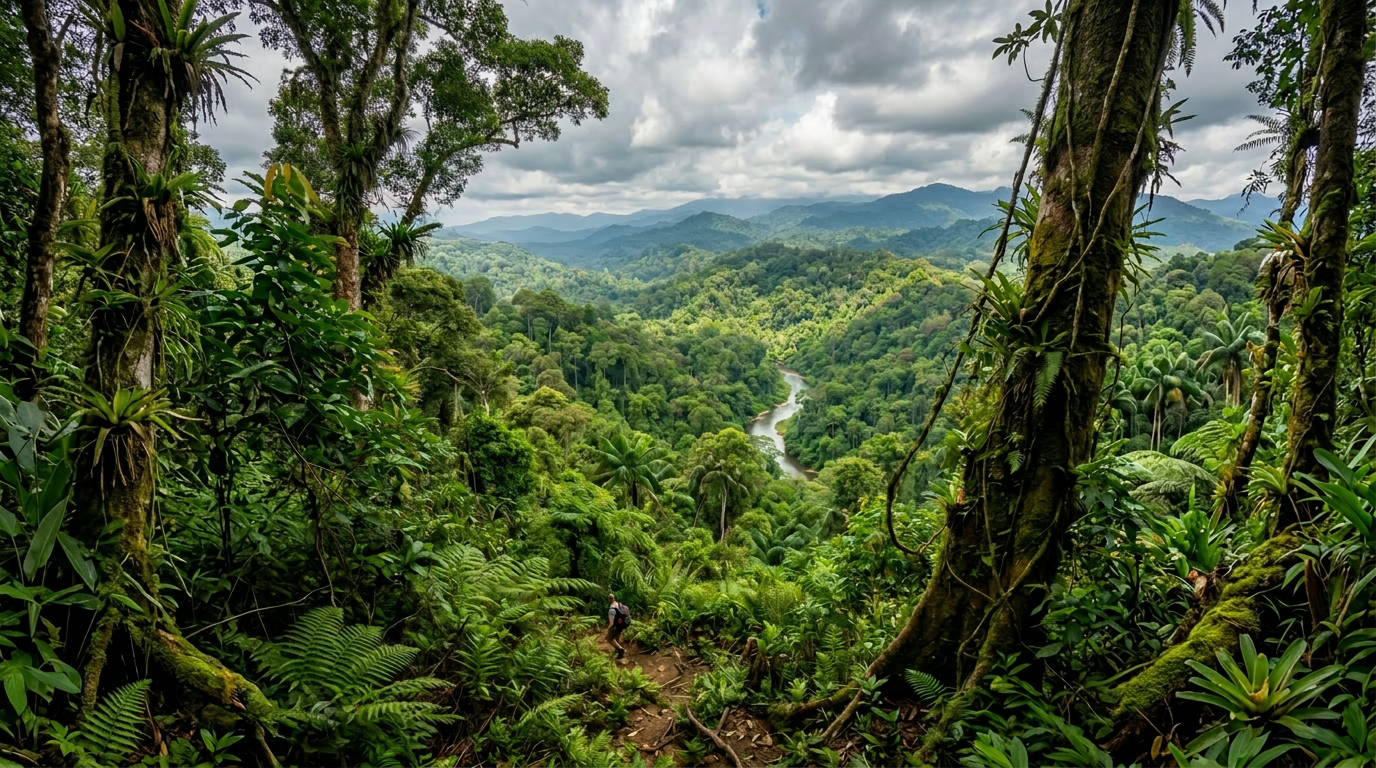
I’d wanted to see orangutans in the wild for years. Since childhood, honestly. (My favourite toy was a stuffed gorilla, which probably tells you everything you need to know about me.) After spending months working with spider monkeys at a sanctuary in Bolivia, the obsession only deepened. Borneo was the original plan, but the flights from Australia never quite worked out.
Then Indonesia happened. I was mid-move from Australia to the UK, got a free trip through work, and realised Sumatra was on the way. The whole package, including airport pickup, the 4-5 hour drive each way, two nights’ accommodation, and a two-day trek with an overnight eco lodge, came to around £350 for both of us. Reasonable does not cover it.
It also fell on my 40th birthday. (I feel very old typing that, and somehow still can’t believe it, but here we are and nothing’s going to change it.) There is nothing more me than spending a milestone birthday sweating through a rainforest hoping to spot a primate. So I booked it.
If you’re the type who researches everything before you go, and you want to know exactly what the Bukit Lawang jungle trek is like, whether you can handle it, what you’ll actually see, and who to do it with: here’s the honest version.
Why Green Hill, and Why It Matters Which Company You Choose
Once I’d decided I was doing this, I researched for weeks. And the more I looked, the more uncomfortable I became. Not all orangutan trek companies operate the same way. Some guides feed the animals. Some get them down from the trees for better photos. Some pile too many people onto routes that can’t sustain the footfall. None of this looks harmful in the moment, but the cumulative impact on habituated wildlife is real.
Green Hill kept coming up. The more I looked into what they actually do (not what they say on their website, but what they actually do), the more they stood out. They’ve rewilded former palm oil plantation land. Their eco lodge sits on what used to be a plantation. They work directly with local communities, enforce strict no-feeding and no-luring rules, and they retrain former hunters as trackers and guides.
That last part is worth sitting with. People don’t hunt for fun. This is a poor area and people take paths that pay them. What Green Hill does, giving those same people a livelihood that depends on the forest surviving rather than being stripped, is what conservation actually looks like from the inside. Not a logo. An actual economic alternative.
Also, when I emailed to ask about vegan food: no hesitation. “Yes, 100% no issue.” Good. I was in. (Read more about why choosing the right company makes a real difference to the orangutans themselves: Ethical Orangutan Trekking in Bukit Lawang: Do It the Right Way.)
What unethical trekking actually looks like
Nobody shows up to a jungle trek planning to harm an orangutan. That is not how it works.
It is subtler. It is a guide who calls one down from the trees because a tourist wants a closer look. It is lunch scraps left on the trail that train macaques to follow humans for food. It is the flu you are carrying that gets passed on through proximity.
On my trek I watched another group’s guide do exactly what Green Hill’s guides would never do: lure an orangutan towards the path. The tourist got their photo. The orangutan learned, again, that humans mean food and closeness. That lesson will outlast the Instagram post by years.
The two that do the most damage:
- Feeding. Even fruit, even scraps left behind by accident. It creates dependency, spreads disease, and takes away their drive to forage.
- Getting them on the ground for photos. Orangutans belong in the canopy. Any guide who brings one down for your camera is telling you exactly what they are.
How Hard Is the Bukit Lawang Jungle Trek?
Honest answer: more manageable than you might expect, with one specific section that is not.
For context: my partner Benicio and I are not particularly fit people. We’ve done the Inca Trail and various hikes in Patagonia and Australia, but that was a few years earlier and neither of us had been doing much since. We went in January, right in the middle of rainy season, against all advice on the internet. (I’m a fan of off-season travel. Something about a torrential downpour makes me feel genuinely alive.)
The heat and humidity were significant, but actually more bearable than a Queensland summer, which we were used to. If you’re coming straight from a British winter, allow a couple of days to acclimatise first. Bukit Lawang is the kind of place that rewards you for slowing down anyway.
The trek isn’t a long distance. It’s the terrain and the conditions that count. Two very different days, too.
Day One: Off the Beaten Track (Literally)
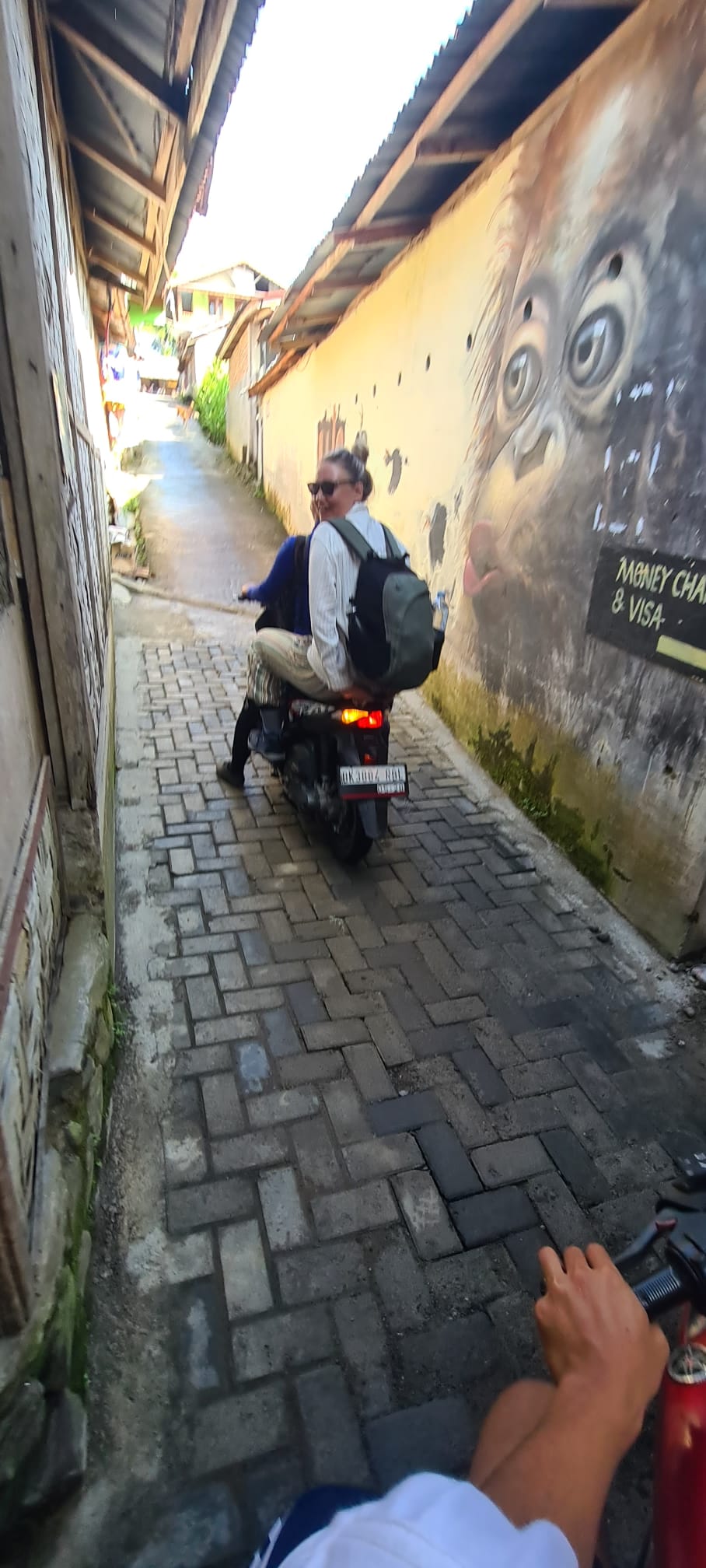
We got picked up from our accommodation in Bukit Lawang on the backs of motorbikes and driven out to a small village near the eco lodge: a handful of homesteads, dogs, chickens, and a general atmosphere of complete tranquillity. Then we met our guide Ando, and our tracker.
The tracker had been a hunter before Green Hill. I understand why that might give some people pause. But the nuance is worth leaning into. This man knew the jungle with a depth that only comes from years of moving through it. Green Hill gave him a different path. He now uses that same knowledge to help people appreciate what’s there rather than take from it. That’s not compromise. That’s change that actually sticks.
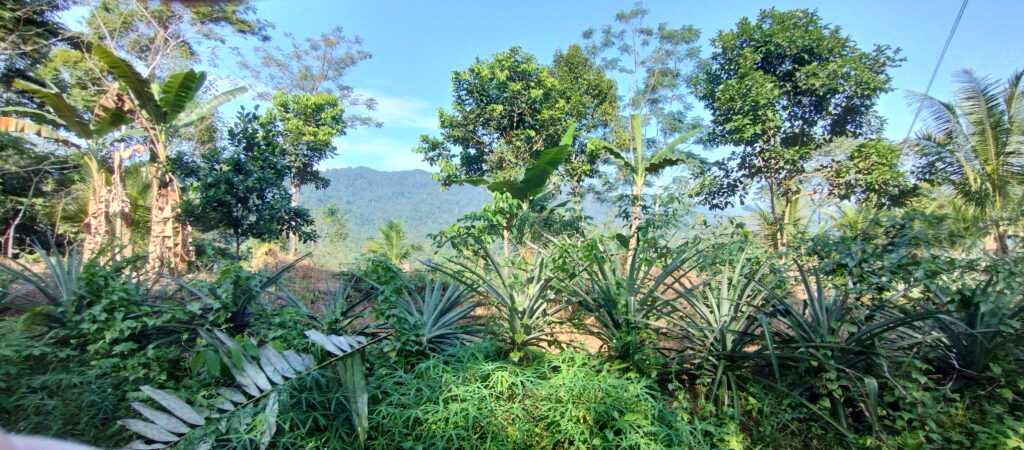
The tracker mixed tobacco leaves with water and carefully applied the concoction to our boots, socks, and trouser hems to deter leeches. Then he pulled out a machete and started cutting us a path. No track. No other tourists. Just the four of us, the sounds of the jungle, and whatever was in it.
About an hour in, he stopped. Signalled. We went still. He’d spotted white-handed gibbons moving through the canopy on a ridge ahead, a family of them, swinging in and out of sight. We watched until they disappeared. I had forgotten my binoculars. Big mistake. Don’t do this.
Over the course of the day we saw giant daddy-long-legs-type creatures sitting on fallen trees, lizards melting perfectly into bark, red-nosed beetles that looked cartoonish, and birds I couldn’t name but watched carefully. The tracker noticed all of them before any of us had thought to look in the right direction.
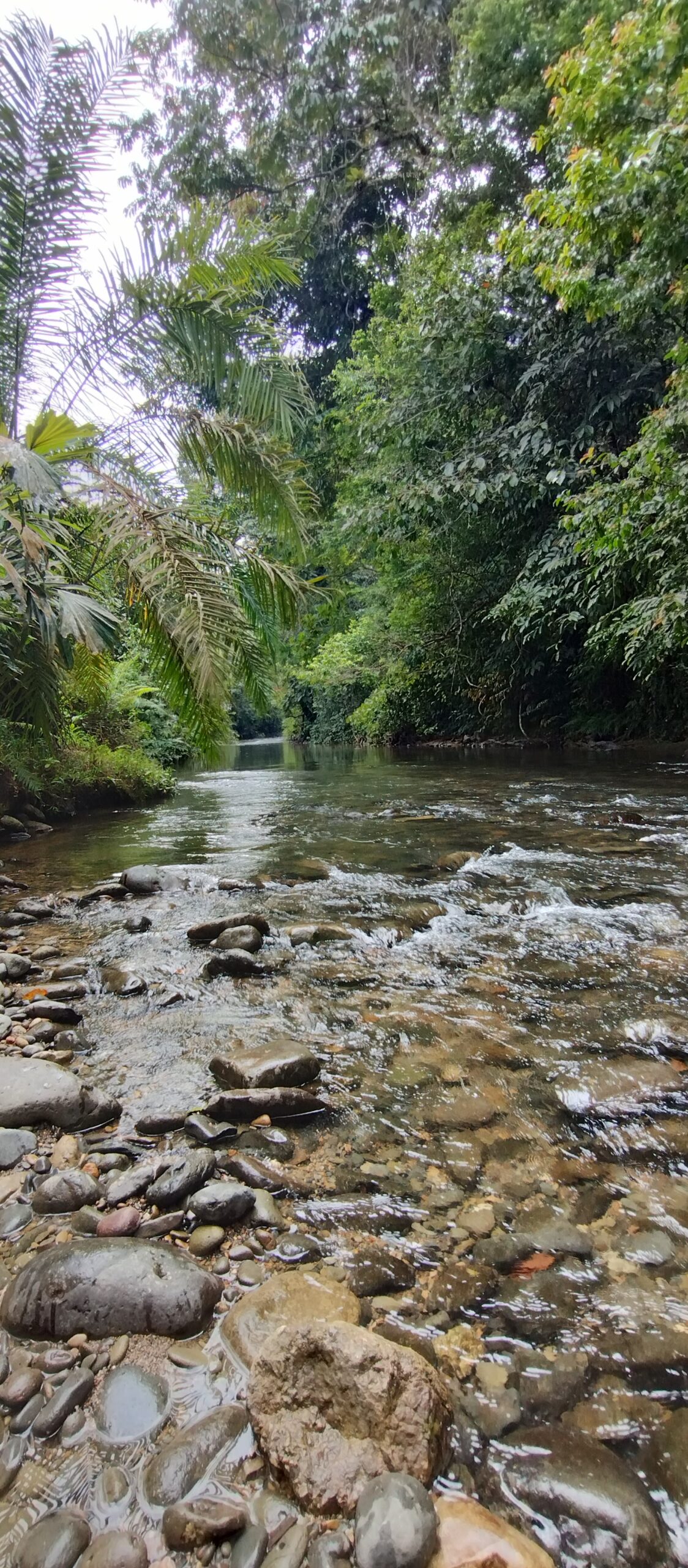
After another hour, we stopped at a stream, took off our boots, and found the results of the tobacco treatment: a handful of dead leeches inside. I reached down to scratch my knee and found one that had beaten the system. Benicio dealt with it without comment. (This happened a few more times. I’m not going to dwell on it, because I don’t want it to put you off, and it genuinely shouldn’t.)
Did we see orangutans that day? No. Did it feel like a disappointment for even a second? No. This was exactly what I came for: a proper wild experience with no guarantee of anything, no track, no crowds, no choreography. We had been in actual jungle with someone who could read it. There’s nothing else like that.
We made it back to the eco lodge just as the light started to change and rain came in. Five hours in. Covered in sweat, jungle, and a moderate quantity of leech bites.
Happy birthday to me.
Sleeping at the Eco Lodge
I had genuinely wanted to camp wild in the jungle. Benicio had drawn a firm line there. I compromised. I was wrong to resist.
The eco lodge is perched on a hillside surrounded by jungle, with a veranda that looks out across the valley and the national park. The shower was a pipe sticking out of a wall with cold water running through it. It was the best shower I have ever had. We sat on the veranda and watched our clothes fail to dry in the humidity, and neither of us minded at all.
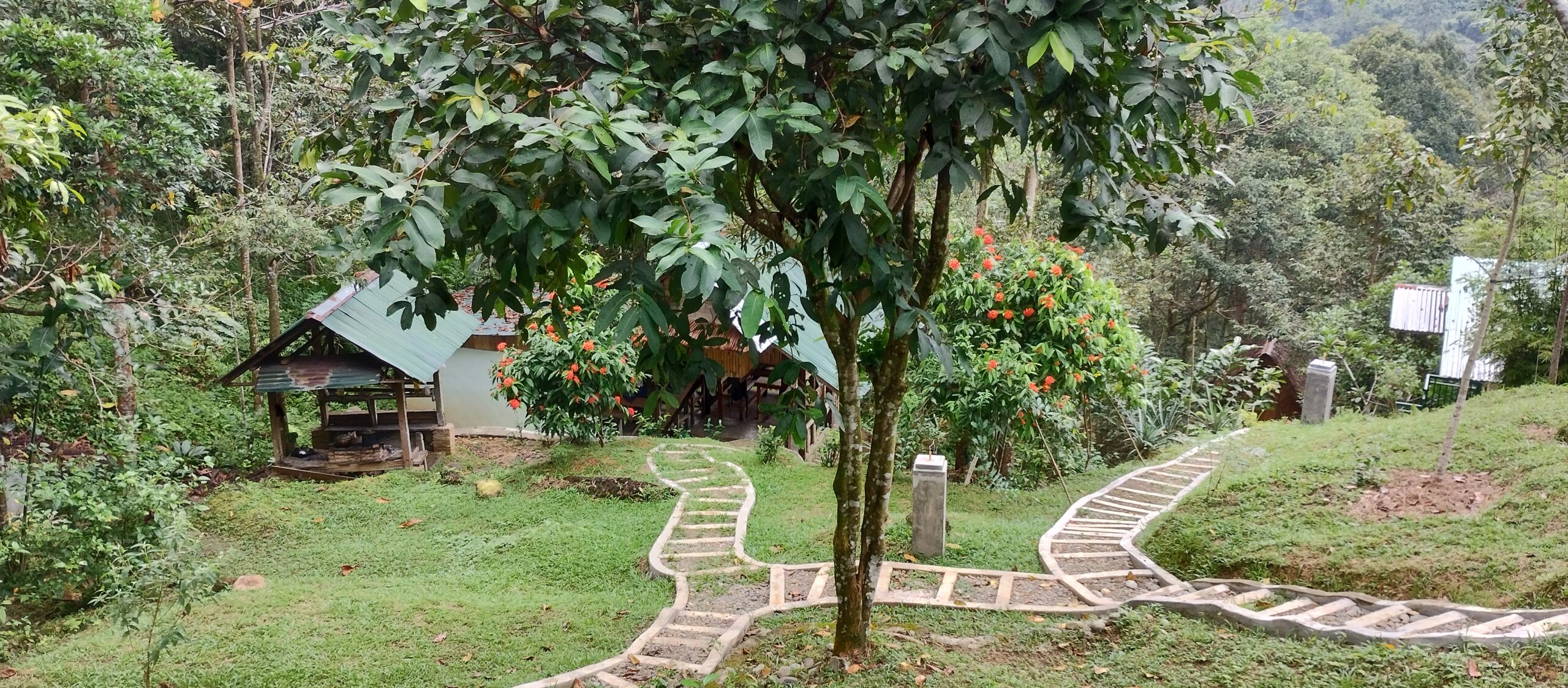
The sun went down behind the hills in those colours you don’t quite believe, and then came the sounds. Loud, echoing calls rolling through the forest from somewhere deep in the canopy. (I thought howler monkeys, which would have been geographically impossible, but my brain went where it went. Almost certainly gibbons.)
Dinner: fried tempeh, potatoes, two different curries, salad, rice, fruit. Completely vegan, cooked fresh in an outdoor kitchen, generous enough for twice the number of people eating it. Not roughing it. Genuinely exceptional food in a genuinely extraordinary place.
Day Two: The Tourist Trail, the Orangutans, and the Descent
Day Two starts from Bukit Lawang itself, walking down through the village to the suspension bridge, crossing over, and heading toward the entrance to Gunung Leuser National Park. We had Ando again today, plus Roy, who was about to become my personal hero in ways I didn’t yet know.
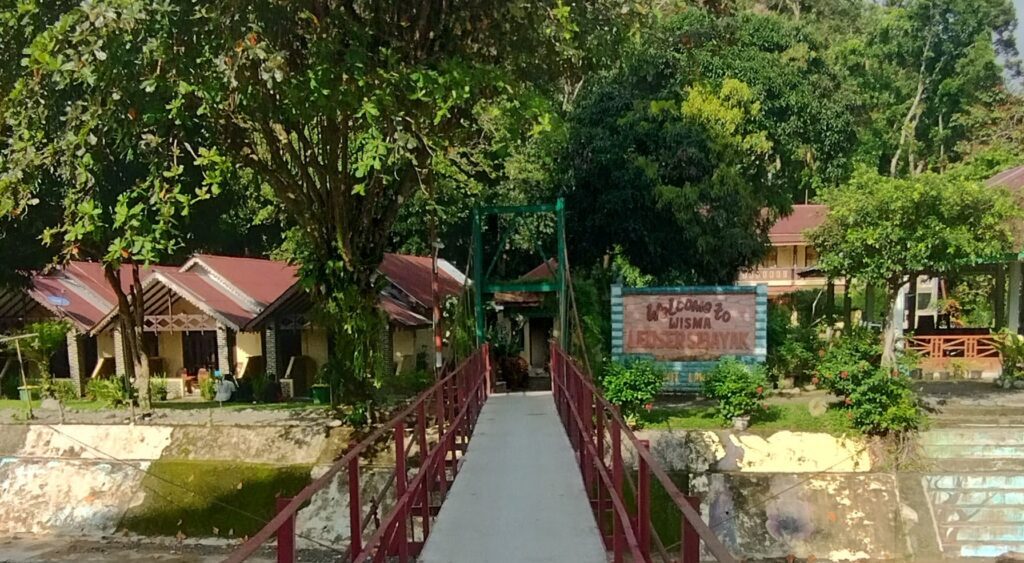
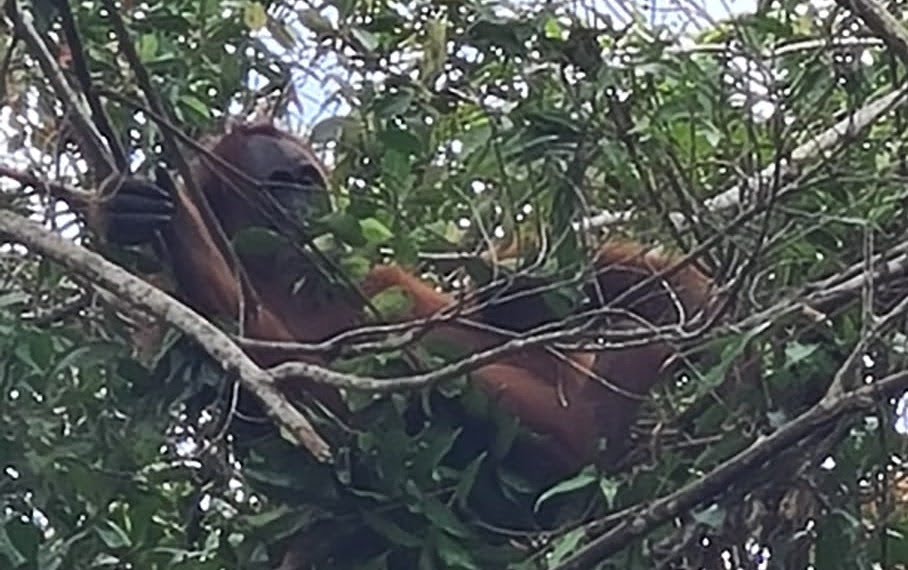
We spotted our first orangutan before we’d even reached the national park entrance. A mother in a nest she’d built from folded branches, swinging one long arm back and forth, watching the small crowd below with the expression of someone who has seen it all before and is mostly fine with it. Then her son appeared, swinging through the trees at speed. Young, energetic, going somewhere with purpose. We followed at a distance and watched him travel through a long expanse of canopy.
Worth noting: the orangutans on this tourist trail are semi-wild, not fully wild. There was a rehabilitation centre in Bukit Lawang until the late 1990s. These animals are used to humans being nearby. That’s why the distance rules matter just as much here, if not more.
Inside the park, we watched Thomas leaf monkeys in the trees. Then, at a fruit break, a long-tailed macaque appeared from the treeline. Not because it was curious about us, because it had learned that tourists leave scraps. Someone had dumped fruit waste behind a tree on the path. The macaque sat watching us eat, running a calculation it had clearly run many times before.
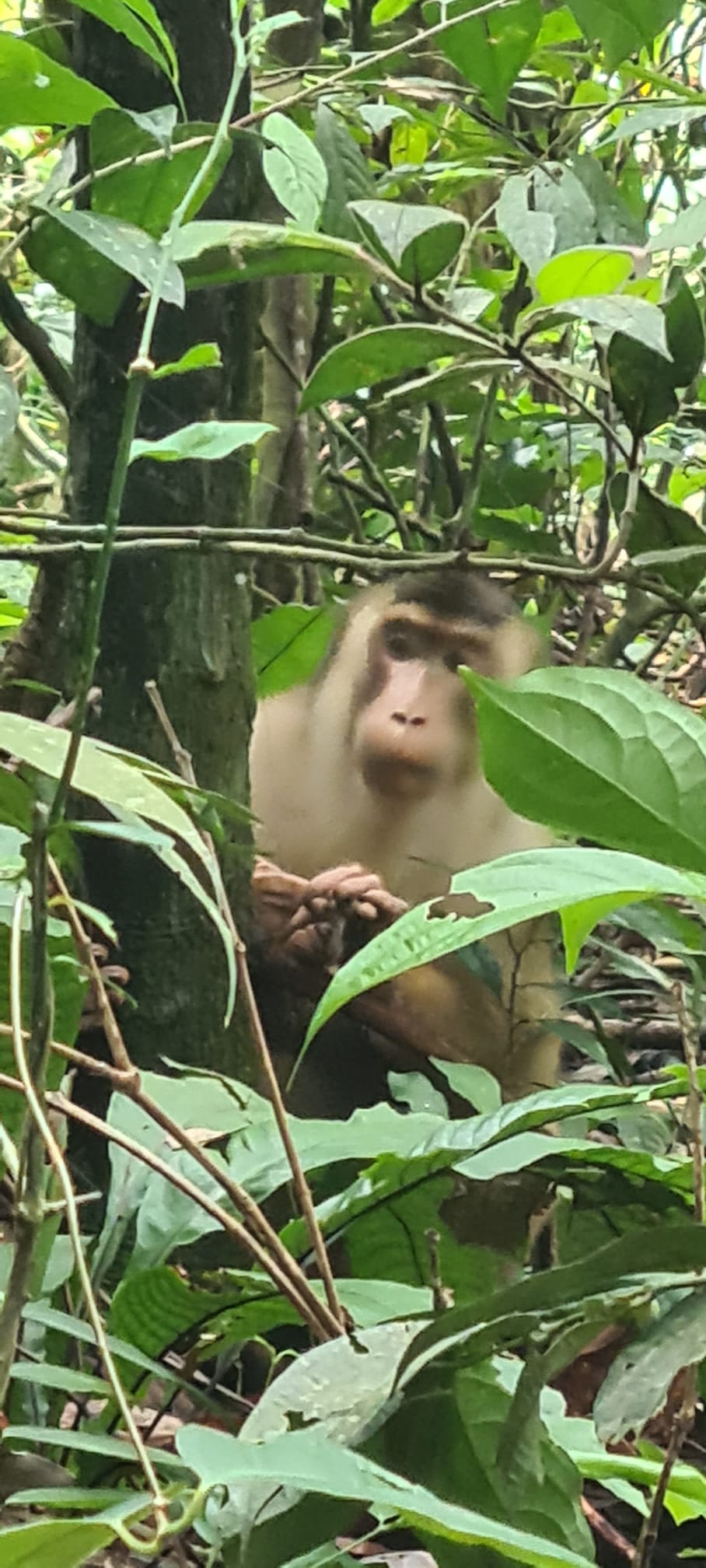
Ando packed up every scrap of our fruit waste and carried it out. No question. That is the difference.
Near the top of the ridge, we overheard another group talking excitedly about an orangutan they’d seen on the ground in front of them. Benicio looked at me, briefly disappointed that we’d just missed it. Then I reminded him: wild orangutans almost never touch the ground. Someone had brought that one down. His disappointment switched immediately to something else.
The orangutans we saw were where they’re supposed to be. Several females resting in nests in the canopy. And then a moment I will not forget: a mother with a very young baby. The baby edged out along a branch, lost its balance, and the mother reached out one arm and drew it back in. Calm, automatic, exactly right. Like watching a reflex older than anything humans have worked out.
Also: a tortoise walked up and made directly for Benicio’s feet. Ando told him to move quickly. They can nip.
The Descent: Roy’s Finest Hour
Ando warned us the downhill was steep. He was not exaggerating. It was essentially a cliff. Muddy, nearly vertical in sections, ropes strung between trees to grip, and the kind of terrain where confident people become considerably less confident very quickly.
Roy was assigned to me. He placed his foot directly in front of mine on every step to stop me sliding. When I grabbed a vine to get down a drop and swung sideways instead, he was already there. At one point I could feel a leech very actively doing its thing at my ankle and made the executive decision that I had more important things to focus on right now. My face went the colour of a tomato. I was extremely grateful for hiking boots.
I made it down. The guides praised me like I’d done something impressive. I had not. Roy had done something impressive.
At the bottom: a waterfall. I jumped in immediately.
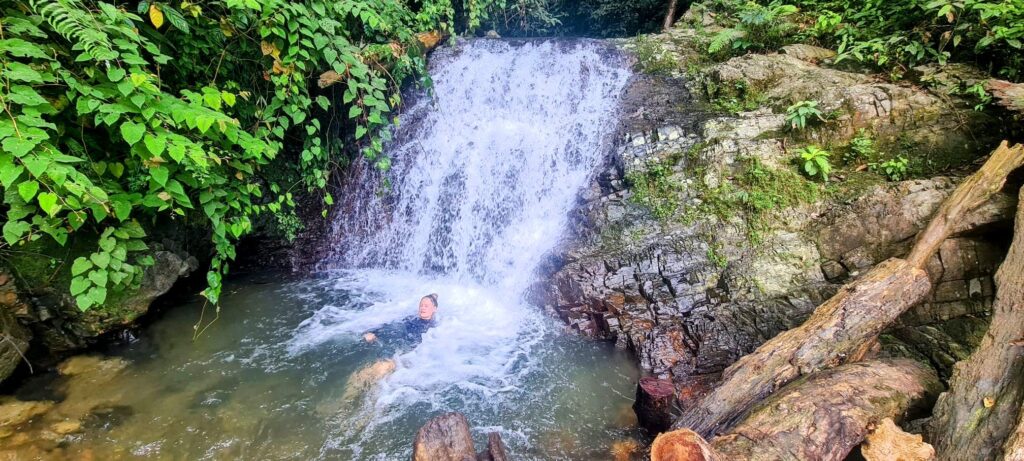
Then lunch. Vegan nasi goreng, fruit platter. One of the best meals of the whole trip.
Roy, the Rapids, and Getting Home
The route back to Bukit Lawang is by raft: giant inflatable rubber rings, three of them tied together with rope. We were in the middle, Ando at the front with an oar, Roy at the back. Thunder was rolling overhead. Ando was anxious. We got in.
The first rapids were brilliant. Then the rain came, heavy and tropical and relentless. We were laughing. Then I looked back at Roy.
Roy was not in the raft. Roy was in the river, scrambling through the current behind us, getting further away. We leaned forward and tapped Ando’s shoulder. He looked back. He had his own moment of alarm. We leaned over the side, arms out, shouting Roy’s name. Somehow Roy caught up, waved our hands away, and climbed back into the moving raft on his own. Through rapids.
Ando was annoyed. Roy took the teasing well when we got back to shore. He’d been through actual white water. He was fine.
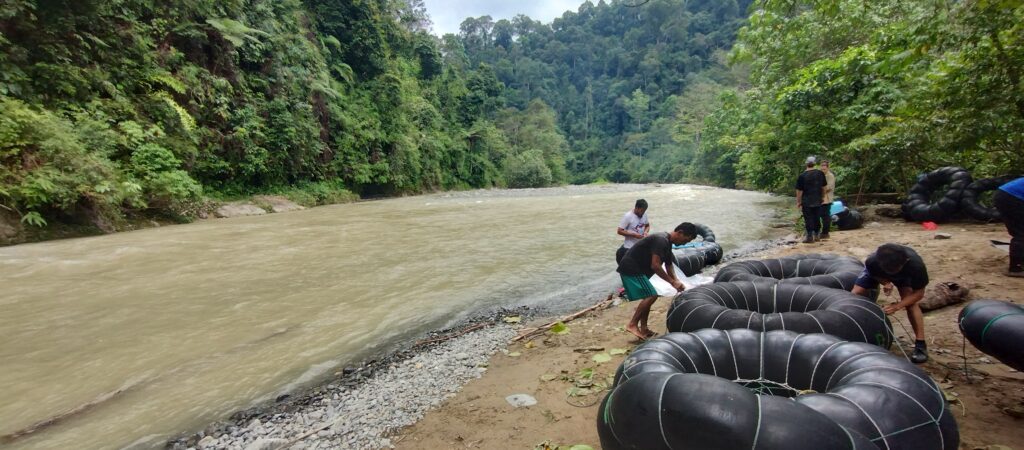
Chaotic. Brilliant. Perfect end to the whole thing.
Questions to ask before you book
If a company hesitates on any of these, walk away.
- Do you enforce a minimum 10-metre distance from all wildlife?
- What happens if an orangutan approaches the group? (The right answer is that you move away.)
- How is food waste managed on the trek?
- Is feeding or touching wildlife ever permitted?
These are not trick questions. A genuinely ethical operator answers them straight away, because the answers are built into how they work.
Around 14,000 Sumatran orangutans are left in the wild. The species is critically endangered, and the step after that is extinction. Your money is leverage. It funds either conservation or exploitation, and you are the one choosing which.
What to Know Before You Go
Cost: around £350 for both of us, full 2-day package including airport pickup, eco lodge overnight, all meals, and guides. Remarkably reasonable for what it actually is.
Season: we went in January, rainy season, against all internet advice, and I would go again. The jungle feels alive. The heat is intense but manageable. If you’re coming from a cold climate, spend a couple of days in Bukit Lawang first to adjust. It’s a genuinely lovely place to slow down in.
Fitness: the trek is moderate overall, taken at a relaxed pace with plenty of stops. The exception is the Day Two descent, which is steep, muddy, and requires proper grip and concentration. Hiking boots are not optional. Trekking poles would be useful.
Leeches: you will get them in rainy season. The tobacco treatment helps. You won’t feel them bite. You will be fine. Do not let this be the reason you don’t go.
Vegan food: completely sorted at Green Hill. Every meal was generous and fresh and felt like actual food rather than an afterthought.
For everything else you need to plan the trip, including where to stay, how to get there, and what Bukit Lawang is actually like as a base, the full destination guide covers it all: Bukit Lawang Travel Guide: What to Know Before You Go.
